Resources
DELTA provides practical resources for scholars, religious leaders, tech leaders, teachers, journalists, young people, and the broader public to help navigate challenges posed by rapidly developing AI.

DELTA 101
New to the DELTA Network? Start here. DELTA 101 materials provide an essential overview of the framework, key vocabulary, and helpful insights that will help you engage this faith-informed lens for human formation in an age of AI. Designed for educators, pastoral ministers, and public leaders alike, these foundational resources will help you navigate the complex intersection of emerging technology, virtue ethics, and human formation.
Opening ND Summit Keynote on the DELTA Framework
Meghan Sullivan, University of Notre Dame

DELTA: A Faith-Based Framework for a
World of Powerful AIAs artificial intelligence becomes more powerful, Christian institutions must look beyond an “ethical floor” of safety, privacy, and transparency. The DELTA framework proposes a deeper, faith-informed approach rooted in enduring Christian values: Dignity, Embodiment, Love, Transcendence, and Agency. We need, as Pope
Francis put it, a growth in human responsibility, values, and conscience that is proportionate to the advances posed by technology.
Critical Systems Heuristics + DELTA
The guide offers a series of questions drawn from Critical Systems Heuristics (CSH) and mapped to the DELTA framework. If CSH is new to you, think of it as a diagnostic tool for something the Catholic tradition of integral human development has insisted on for a very long time: that persons can’t be reduced to any single dimension of their lives, and that the people most affected by a decision should be part of making it.

Educational Resources
As artificial intelligence reshapes education, we want our students to grow in wisdom, not just digital fluency. Explore our collection of lesson plans, pedagogy tools, and institutional strategies that were built to help educators and parents navigate AI through the lens of DELTA.

Teaching Examen
This Teacher’s Examen helps faculty reflect on the most important part of their work: the human part. Using the five DELTA principles, it invites educators to reexamine their classrooms—to consider how personal and human they currently are and should be in an era of increasingly fragmented and disembodied learning.
While useful for individual reflection, the Examen is also a great way for school leaders to begin or end a semester or academic year. Use it with faculty on retreat, during start-of-year orientation, or as part of ongoing professional formation. Better yet, this is not a one-and-done reflection. Keep it on your desk and return to it again and again.
Invitation to Learn
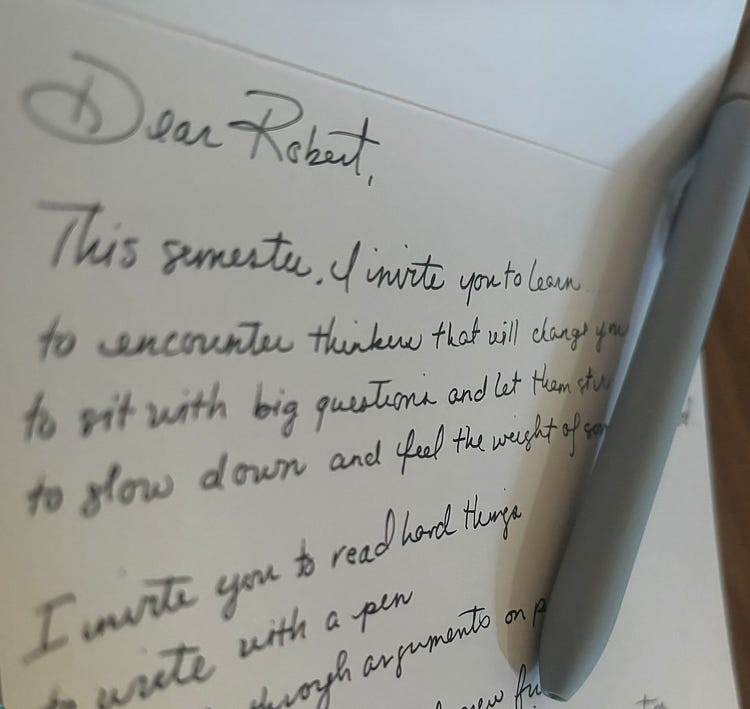
Start your course or school year with an Invitation to Learn—welcome students into the hard, messy work of growing in understanding. Use these words, write your own, or amend the invitation to speak directly to the students at your school or university.
This invitation works best when handwritten. Our squiggly words, written in pen on paper, communicate care. But that is not always feasible when teaching a lecture of 200 students—or three sections of 40! Instead, print the invitation, handwrite each student’s name at the top, and add your personal signature at the bottom.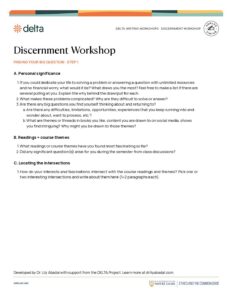
Scaffolded Writing Workshops
These Writing Workshops are designed for in-class, analog writing and are specifically geared toward thesis-driven, argumentative work. Their purpose is to preserve student agency and the integrity of the traditional term paper. Students are asked to slow down, find their voice, bring their raw thoughts to the page, and mold them over time—a process that is increasingly easy and tempting to outsource without structure and in-person guidance.
The workshops work particularly well when students have one dedicated place to complete them. You can purchase inexpensive notebooks or composition books, or ask students to bring their own. The important thing is that students use the same dedicated notebook throughout the process.
Each workshop should take roughly 30–45 minutes of class time, though you can allow more when time permits. Print off copies so students have the instructions on paper in front of them.
If students choose their own paper topics, begin with the Discernment Workshop. If you provide a selection of prompts, you can skip that session.
Though designed with undergraduates in mind, the structure works equally well in high school and even in graduate seminars.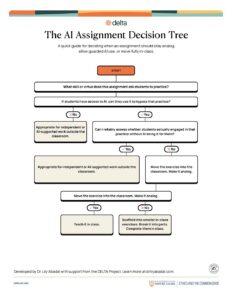
AI Assignment Decision Tree
“How should student assessment change in the AI era?” has become one of the most challenging questions facing educators. This Decision Tree simplifies the question so you can think clearly about what needs to change, what should remain, and how you might redesign assessment without abandoning the goods assessment is meant to cultivate. It’s a great resource to align decision making without overly prescriptive or top-down policy.
The Decision Tree begins with two basic premises: practice is necessary for the development of both skill and character and novices need boundaries as they learn a new practice. From there, it helps educators distinguish between the work students need to do themselves and the places where AI might appropriately enter the learning process.

Pastoral Ministry Resources
Artificial intelligence is raising age-old questions about what it means to be human, to have a soul, and how to lead a fulfilling life. Thankfully, the Christian church has been wrestling with these questions for thousands of years! This hub equips pastoral leaders, youth ministers, and faith formation leaders with theological insights and practical tools to help navigate these enduring questions in the context of AI’s evolving capabilities.
Explore discussion guides, sermon frameworks, and parish and congregational resources designed to address technological anxiety with pastoral care, ensuring that simulated connection never replaces authentic, grace-filled human community.
Project 1232
Equipping Pastors for the AI Age.
Recommended Reading List
Staying informed is essential as artificial intelligence continues to bring rapid change to our world and as we strive to form moral human beings in the midst of it all. Check out our team’s curated reading list to stay up to date, explore new ideas, and challenge your perspectives.